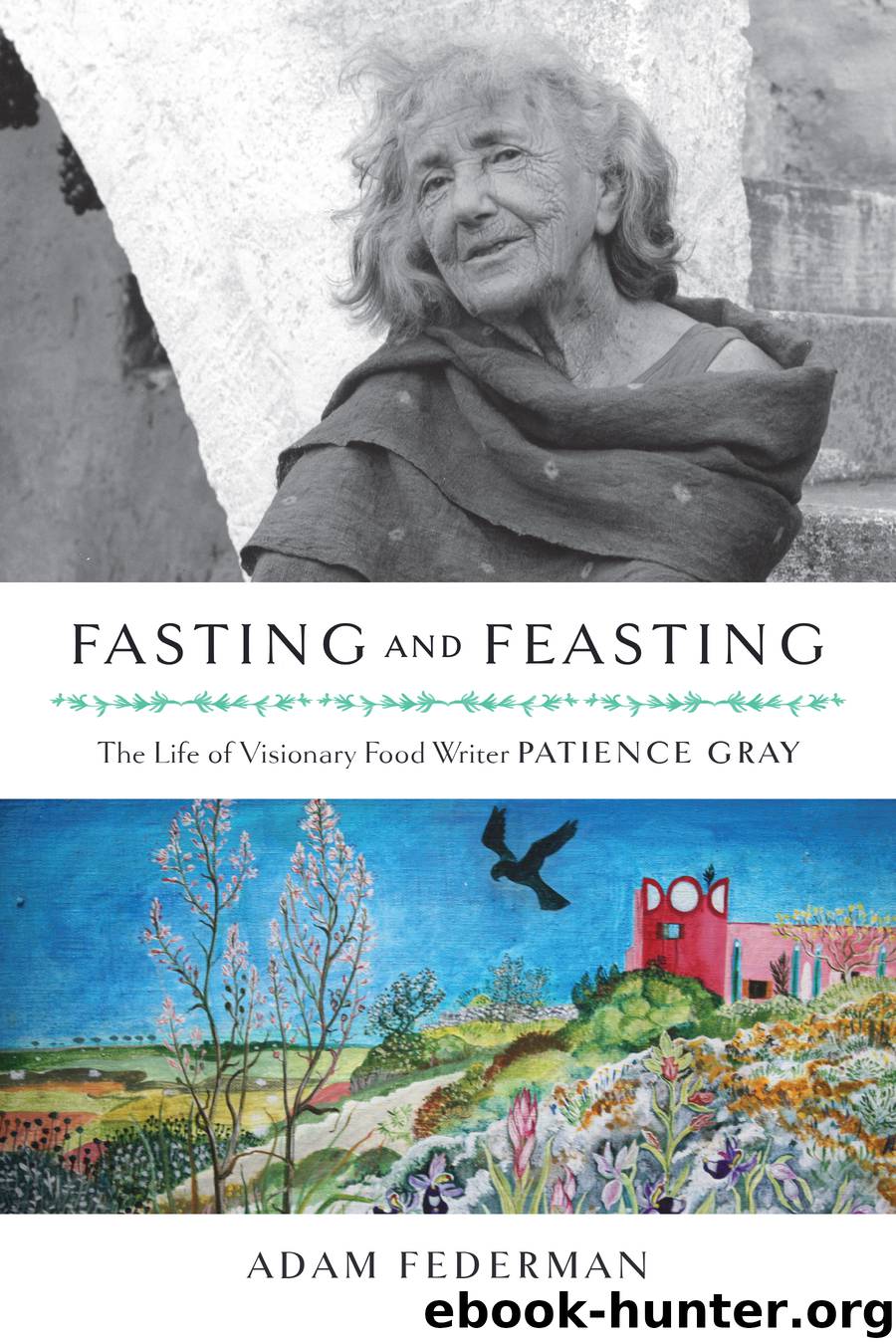
Fasting and Feasting by Adam Federman
Author:Adam Federman
Language: eng
Format: epub
Publisher: Chelsea Green Publishing
Published: 2017-05-24T23:53:50+00:00
They spent two weeks in the Salento, the jagged peninsula that forms the heel of Italy’s boot, camping along the beaches and touring the “Neolithic” countryside. Indeed the landscape, relentlessly flat and dominated by ancient olive groves and pale blue seas in every direction, was spellbinding. Patience had trouble putting into words the feelings it evoked in her. (She had traveled to part of Puglia before with Irving but had not ventured south of Lecce, the province’s largest city.) It was both bracing and somewhat terrifying. In her eyes it seemed to strip away everything incidental and lay bare what really mattered. Helen said that the “olive-studded, rocky landscape and blue skies” reminded her of her childhood in Palestine.38 In an unpublished essay Patience described Puglia as “an image of wilderness,” not only in the sense that it was relatively untouched but that it was somehow impenetrable and unknowable. In a letter to Ariane, she said it was like seeing the world “before there was a single human being on it.” She added, “Of course I can’t explain. Anyway it is a bare and desolate place where nothing earthly really matters.”39
Of course they had gone to look at property and were dealing with the very earthly task of buying a house or farm. On the Ionian coast they found what Patience described as a “ruined farm”—“it was just like Greece,” she wrote, “a fortress built on rock, and covered with asphodel”—which they nearly rented for a year before discovering that they would have had to share it with “beasts and people.”40 Many of the old farmhouses, the masserie, though somewhat abandoned were still used by farmers, peasants, and shepherds who sometimes smoked their cheeses in the vaulted rooms or simply used them for shelter. Other buildings, which looked promising from afar, turned out to be nothing more than “palatial cow stalls.” “We longed to acquire a few stone huts and an almond orchard,” Patience wrote. “But everyone offered us hectares of olives and agricultural responsibilities!”41
The dazzling landscape was complemented by the glorious autumn weather. Temperatures were in the mid 60s and the air bone-dry. The sea was still warm enough for swimming. Norman, who succumbed easily to colds and the flu, found the climate favorable compared to the frequent cold and damp of Carrara. They camped on the beaches, sleeping in the back of the lorry. Patience gathered what she called “small narcissus bulbs,” in fact a sea daffodil growing on the dunes, that she later sent to Olive. She made note of a “delicious salad weed called rugola” (rocket), which she described as “a sort of wild mustardy dwarf cabbage.” She collected herbs everywhere and had her first real taste of the macchia, the dense scrubland that defines so much of the coastal Mediterranean. It was a completely foreign landscape in many ways—fantastically diverse—with a profusion of wild herbs, edible plants, and dwarf trees. Her only point of reference was Greece, and of course Puglia was part of that
Download
This site does not store any files on its server. We only index and link to content provided by other sites. Please contact the content providers to delete copyright contents if any and email us, we'll remove relevant links or contents immediately.
Cecilia; Or, Memoirs of an Heiress — Volume 2 by Fanny Burney(31960)
Cecilia; Or, Memoirs of an Heiress — Volume 3 by Fanny Burney(31945)
Fanny Burney by Claire Harman(26607)
We're Going to Need More Wine by Gabrielle Union(19054)
Plagued by Fire by Paul Hendrickson(17417)
All the Missing Girls by Megan Miranda(16052)
Cat's cradle by Kurt Vonnegut(15365)
For the Love of Europe by Rick Steves(14177)
Bombshells: Glamour Girls of a Lifetime by Sullivan Steve(14081)
Leonardo da Vinci by Walter Isaacson(13341)
4 3 2 1: A Novel by Paul Auster(12405)
The remains of the day by Kazuo Ishiguro(9006)
Adultolescence by Gabbie Hanna(8931)
Note to Self by Connor Franta(7673)
Diary of a Player by Brad Paisley(7587)
Giovanni's Room by James Baldwin(7354)
What Does This Button Do? by Bruce Dickinson(6210)
Ego Is the Enemy by Ryan Holiday(5456)
Born a Crime by Trevor Noah(5385)
